 Axelar
 token transfers and cross-chain messaging
Last updatedAxelar connects blockchains so applications can transfer supported tokens and send messages that trigger smart contracts on another chain. Its proof-of-stake network supplies the shared infrastructure behind those interactions. General Message Passing carries application data, while Interchain Token Service supports token deployment and movement across supported networks. Gateways and relayers connect these services to individual blockchains. Available assets, gas arrangements, and destination actions depend on the integration that an application uses.
Article sections
Token transfers and contract messages serve different purposes
A token transfer moves a supported asset between chains; General Message Passing, or GMP, carries data for a destination application. A message can specify an action that a receiving smart contract understands.
Supported GMP interfaces can also attach tokens to a contract call. This makes asset movement and application instructions available together, subject to the token and contract support of that integration. Delivering tokens changes where the recipient can use an asset. Executing a message invokes the receiving contract’s programmed operation. The receiving contract determines how it interprets that message and which actions it permits. An application must implement the relevant receiving logic before it can use arbitrary cross-chain data.
Token services and trading access build on the network
Supported wrapped gateway tokens provide one transfer model. Interchain Token Service addresses token integration and deployment, while Fullport provides institutions with access to onchain trading venues.
Interchain Token Service
Interchain Token Service, or ITS, supports creating new interchain tokens and integrating existing tokens on supported chains. In its EVM implementation, it works with ERC-20 tokens. EVM means Ethereum Virtual Machine, the execution environment that these chains share. Token managers connect each token integration to the service and handle controls such as locked balances and transfer flow limits. The token setup determines how movement between chains affects those balances. Creating or connecting a token establishes its integration. Holders can then use the transfer functionality that the deployed token and receiving network support.
Fullport and finance applications
Fullport provides institutions with access to Hyperliquid. ITS also supports distribution of stablecoins, tokenized real-world assets, and funds. Each application adds its own supported assets and actions. Axelar lists its separate yield offering for XRP and Stellar as coming soon. Yield-oriented applications require a separate return mechanism: successful token delivery alone creates no accrued yield.
Gateways, validators, and relayers have different jobs
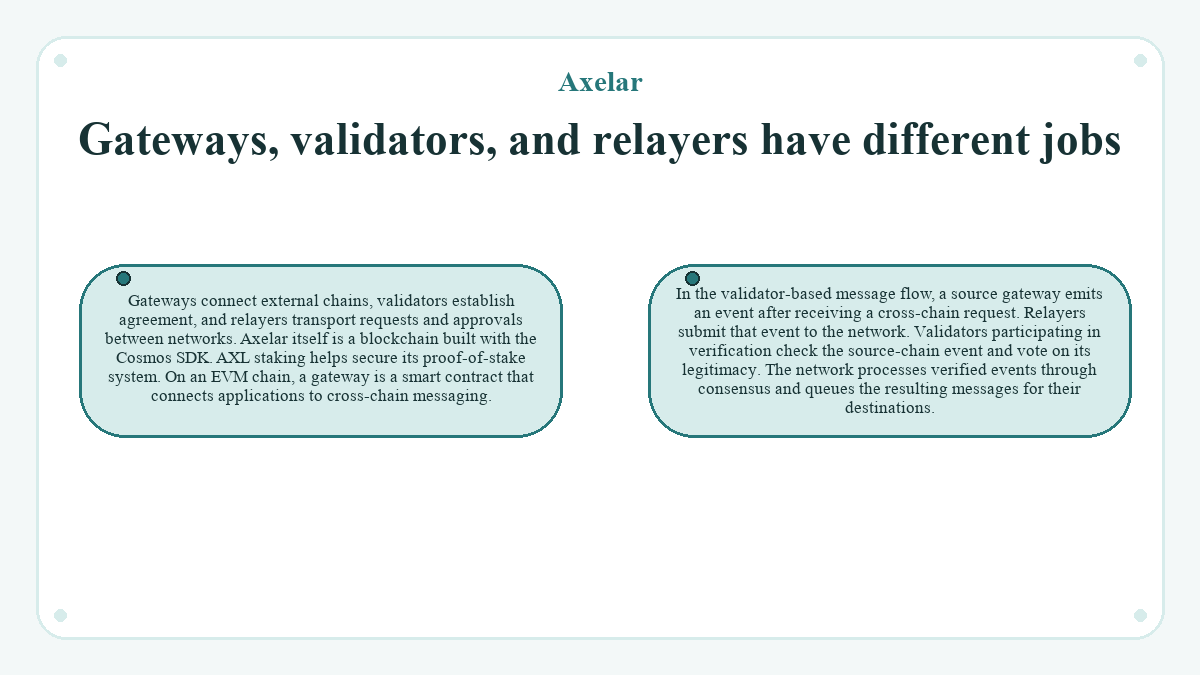
Gateways connect external chains, validators establish agreement, and relayers transport requests and approvals between networks. Axelar itself is a blockchain built with the Cosmos SDK. AXL staking helps secure its proof-of-stake system. On an EVM chain, a gateway is a smart contract that connects applications to cross-chain messaging.
In the validator-based message flow, a source gateway emits an event after receiving a cross-chain request. Relayers submit that event to the network. Validators participating in verification check the source-chain event and vote on its legitimacy. The network processes verified events through consensus and queues the resulting messages for their destinations.
Approval and execution
Gateway approval
The destination gateway records approval of a contract call before the receiving application executes its payload. Threshold authorization precedes delivery of that approval. A relayer carries the authorized message to the destination chain; transporting it does not give that relayer permission to invent an approved call.
Destination execution
The receiving application needs an execution transaction and destination-chain gas to run its requested function. An approved message can await execution or fail because of insufficient gas or incompatible destination contract logic.
What determines an Axelar transaction’s fee and duration?
Cross-chain costs reflect source-chain submission, network processing, destination relaying, and the work that the destination contract performs. GMP pricing combines a route-dependent network base fee with a destination execution fee. Contract complexity affects the execution requirement. Gas prices and currency conversion rates affect the payment estimate, so an old transfer quote cannot establish the cost of a different route. Source-chain finality and network congestion also affect completion time. Different routes can require different confirmation periods, and destination execution introduces another dependency. A source transaction’s inclusion in a block does not establish completion on the receiving chain.
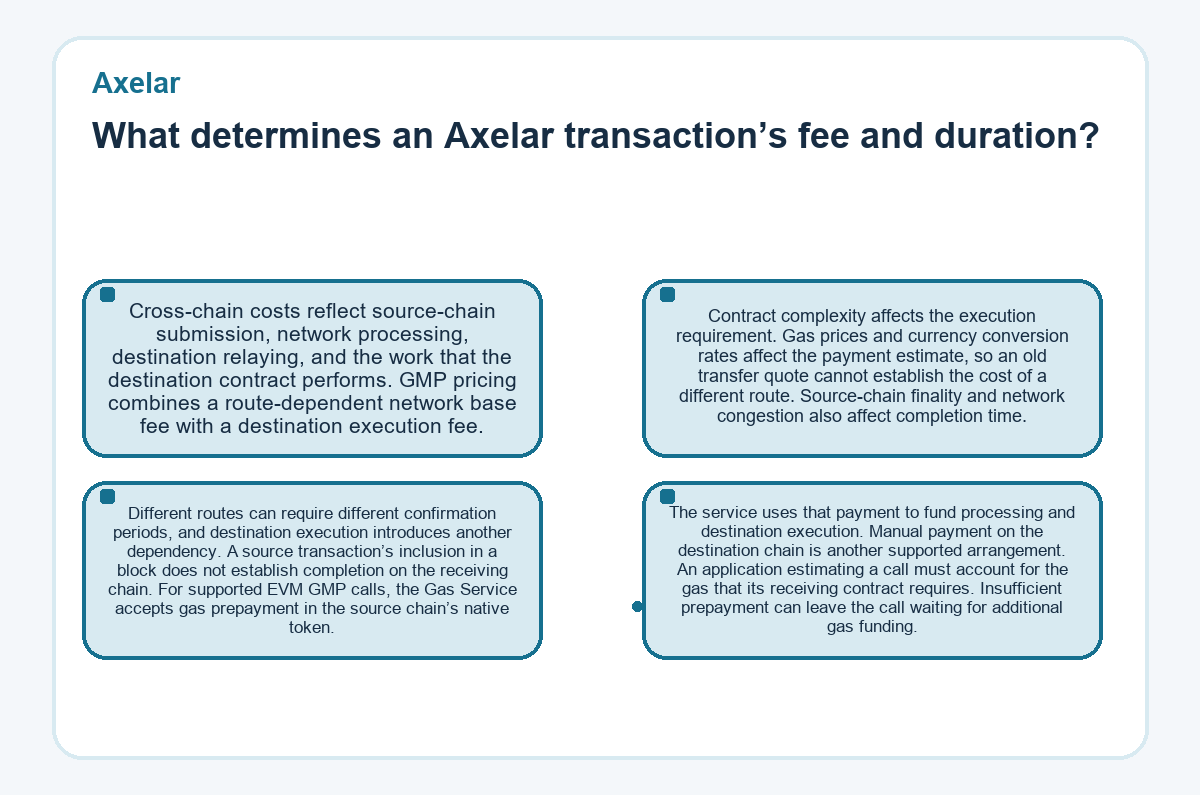
For supported EVM GMP calls, the Gas Service accepts gas prepayment in the source chain’s native token. The service uses that payment to fund processing and destination execution. Manual payment on the destination chain is another supported arrangement. An application estimating a call must account for the gas that its receiving contract requires. Insufficient prepayment can leave the call waiting for additional gas funding.
Transfer access changes with the interface and asset
Satellite, the earlier transfer application, has been retired. Its deposit-address transfer route is disabled. Do not use the former Satellite website; Axelar no longer controls it. Supported transfers now use the current Axelar transfer interface or an applicable third-party integration. The direct interface exposes selected assets and chains; its available routes can differ from the wider network’s capabilities.
Moving a token and invoking a contract require different application support.
- For asset delivery, confirm that the application supports the exact token and destination chain.
- For a destination contract action, use an integration that supports GMP and the intended receiving contract.
- For ITS deployment, distinguish creating a new token from connecting an existing token.
- With source-chain gas prepayment, include the destination execution requirement in the payment estimate.
- With manual execution, obtain the destination chain’s native gas token before submitting the execution transaction.
Execution failures and transfer limits affect completion
Insufficient prepaid gas can stop relaying, while incompatible destination logic can cause an approved call to fail. Axelarscan exposes GMP status and execution details, searchable by source transaction hash or sender address. Its execution record distinguishes a successful destination call from an execution error. Additional gas addresses a funding shortfall; it does not repair incompatible contract logic.
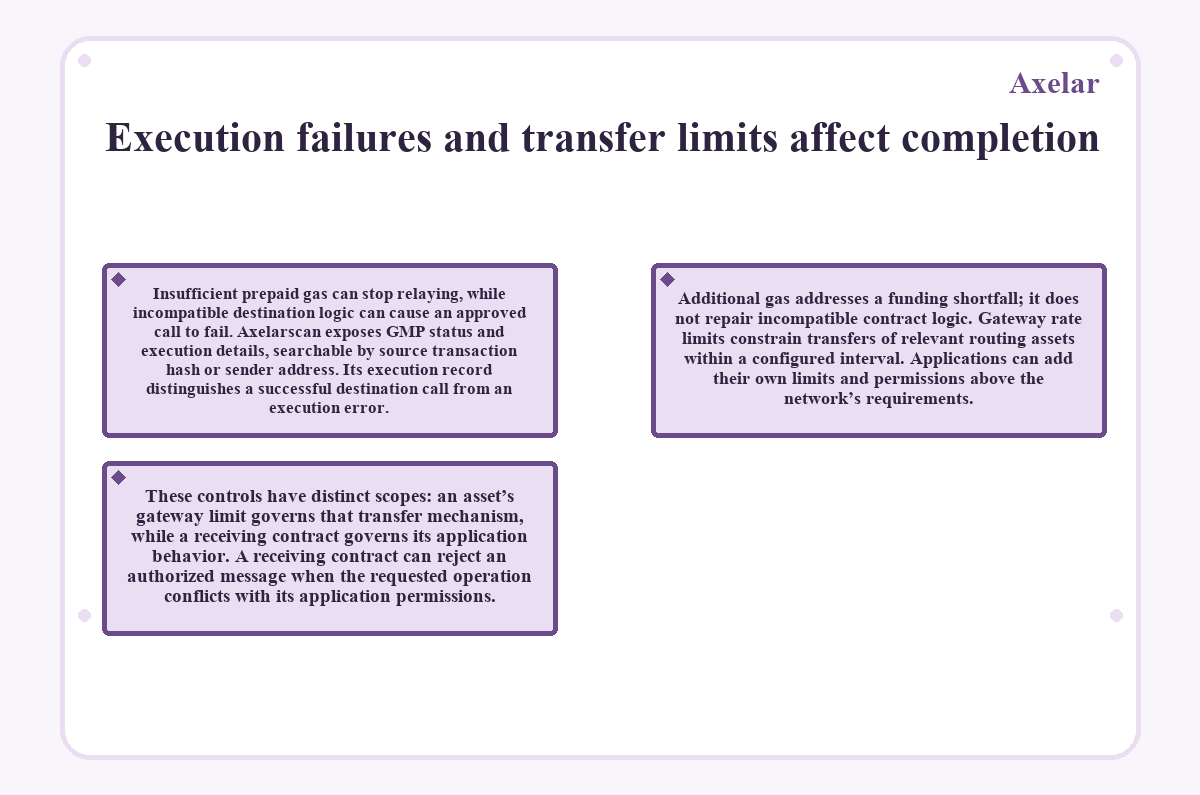
Gateway rate limits constrain transfers of relevant routing assets within a configured interval. Applications can add their own limits and permissions above the network’s requirements. These controls have distinct scopes: an asset’s gateway limit governs that transfer mechanism, while a receiving contract governs its application behavior. A receiving contract can reject an authorized message when the requested operation conflicts with its application permissions.
Axelar - your questions answered
-
Do I need to hold AXL to pay for a GMP call?
- You do not need to hold AXL when the application uses supported source-chain native-token gas prepayment. The Gas Service handles the currencies needed for cross-chain processing and destination execution. That payment arrangement differs from staking AXL to secure the network; the application’s integration determines which gas payment methods it exposes.
-
Where does unused prepaid gas go?
- Unused GMP gas can return to the refund address specified when the application pays the Gas Service. In the native-token prepayment integration, the refund takes place on the source chain. The recipient can differ from the original caller. Network, execution, and refund-processing costs reduce the refundable remainder.
-
Can a GMP call return a message to its source chain?
- The Gas Service supports a destination contract sending a return GMP message when the source payment covers the round trip. Each direction needs its own gas estimate because execution and relaying costs can differ. If funding for the return call is insufficient, that call waits for additional gas payment.
-
Who can operate the relayer services?
- Anyone can run relayer services for the documented validator-based flow. Relayers observe source-chain events or deliver authorized messages to destination chains. Their transport role does not replace event verification or threshold authorization.
-
Must every validator run a node for every connected blockchain?
- The validator-based network design does not require every validator to operate a node for every supported chain. Validators verify events on the external chains that they support. The design incentivizes supporting additional chains through staking rewards, while the applicable chain integration determines participation in event verification.
-
Is writing a custom contract necessary to create an interchain token?
- The ITS no-code portal can deploy a new interchain token without requiring its creator to write a custom token contract. It also offers a separate path for connecting an existing token. Deployment requires funding on the selected source network, and the chosen chains must support the relevant token integration.
-
Does Axelar hide the sender of a cross-chain message?
- GMP activity is publicly searchable by sender address or source transaction hash through Axelarscan. Transaction details expose information about the source call, gas payment, approval, execution, and any recorded refund. Cross-chain delivery therefore does not itself provide transaction privacy or conceal the address associated with the message.