 Axelar
 staking through native AXL delegation
Last updatedAxelar staking lets holders delegate native AXL to network validators, with eligible delegations accruing protocol rewards. An ERC-20 representation on another chain needs conversion to native AXL on Axelar before delegation. The resulting stake connects a delegator account with a selected validator. Reward accounting, governance votes, and returning principal to a spendable balance involve different actions. A submitted transaction needs successful onchain execution before it establishes a delegation.
In short: A successful native AXL delegation records participation with a validator; accrued rewards and spendable principal require separate accounting.
Native AXL delegation and its onchain record
A spendable native AXL balance supports direct delegation to a validator that participates in Axelar consensus. Validators maintain the proof-of-stake blockchain behind services including General Message Passing and Interchain Token Service. Delegation contributes stake to that network; using either cross-chain service creates a different transaction.
The native balance and compatible wallet
Keplr and Cosmostation support native AXL staking through Cosmos-compatible accounts. An AXL balance displayed on an EVM chain represents a different token instance. A conversion intended to prepare tokens for staking must deliver native AXL on Axelar. Merely moving the wrapped token between EVM chains leaves that prerequisite unmet.
The wallet prepares a staking transaction that specifies the account, validator, and amount. Its confirmation also identifies the transaction fee. Keep a spendable fee reserve when choosing the delegation amount, because bonded tokens cannot fund ordinary wallet transactions. Reviewing these details leaves the proposed stake uncommitted until authorization and submission.
Successful execution and the delegation balance
A transaction hash identifies an operation; the chain result establishes whether execution succeeded. The delegation record then identifies the stake associated with the account and validator. Matching these records avoids treating an unsuccessful submission as participation. Validator status also matters: recording a delegation does not establish that its validator currently earns protocol rewards.
Direct delegation suits native AXL holders who want to support consensus and earn staking rewards. Keeping tokens spendable serves a different need when they must remain available for transfers. The amount committed to staking loses immediate transferability, so an expected reward rate cannot settle that liquidity decision.
Can staked AXL participate in network governance?
Staked AXL supports governance participation on network proposals, including parameter changes and protocol upgrades. A personal vote requires a voting action that identifies the proposal and voting choice. A successful voting transaction records the account’s choice for that proposal. The proposal tally and final status establish the collective outcome. A completed staking transaction alone does not record a personal vote or show that a proposal passed.
Reward balances, commission, and validator performance
Validator commission comes from staking rewards. Accrued rewards and bonded principal represent different balances. Claiming rewards and increasing a delegation therefore have different effects, even when a wallet combines actions in one interface.
Accrued AXL and annual estimates
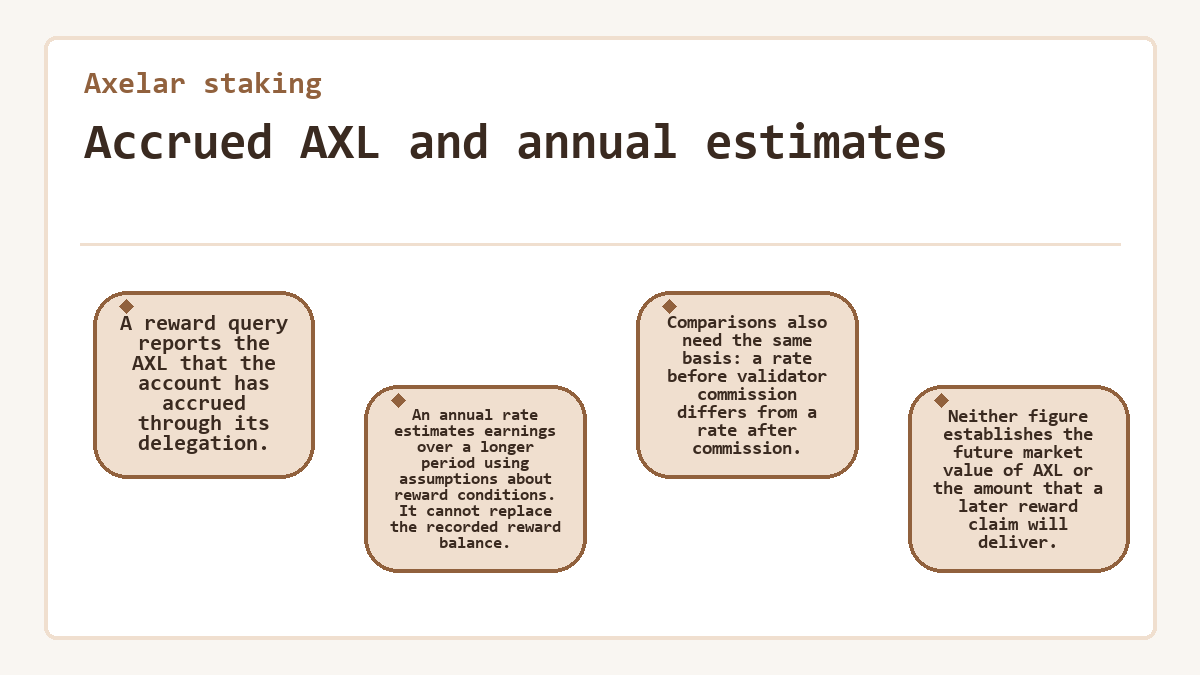
A reward query reports the AXL that the account has accrued through its delegation. An annual rate estimates earnings over a longer period using assumptions about reward conditions. It cannot replace the recorded reward balance. Comparisons also need the same basis: a rate before validator commission differs from a rate after commission. Neither figure establishes the future market value of AXL or the amount that a later reward claim will deliver.
Validator service and separate incentive pools
An active validator must perform its network duties, and protocol penalties can affect delegated stake. Uptime and validator status therefore matter alongside commission. Axelar also has distinct incentive mechanisms: Interchain Amplifier funds verifier rewards through AXL pools for chain connections. Those pools do not automatically become rewards for an ordinary consensus delegation. Likewise, a protocol token burn does not credit AXL to a delegator.
When does undelegated AXL become spendable?
Undelegated AXL becomes spendable when the chain completes its unbonding entry and returns the remaining balance to the account. An accepted undelegation begins that process. Closing a staking dashboard or disconnecting a wallet leaves an existing delegation unchanged.
The waiting period and completion time
An undelegation creates an unbonding entry with a completion time.
The network’s
unbonding_time
parameter determines the waiting period when the chain creates that entry. The staking params query reports its current value. The entry’s completion time applies to the particular withdrawal. An unsigned request or a transaction awaiting inclusion has not created that record. A wallet’s estimated availability date therefore needs the corresponding accepted undelegation.
The amount leaving the delegation
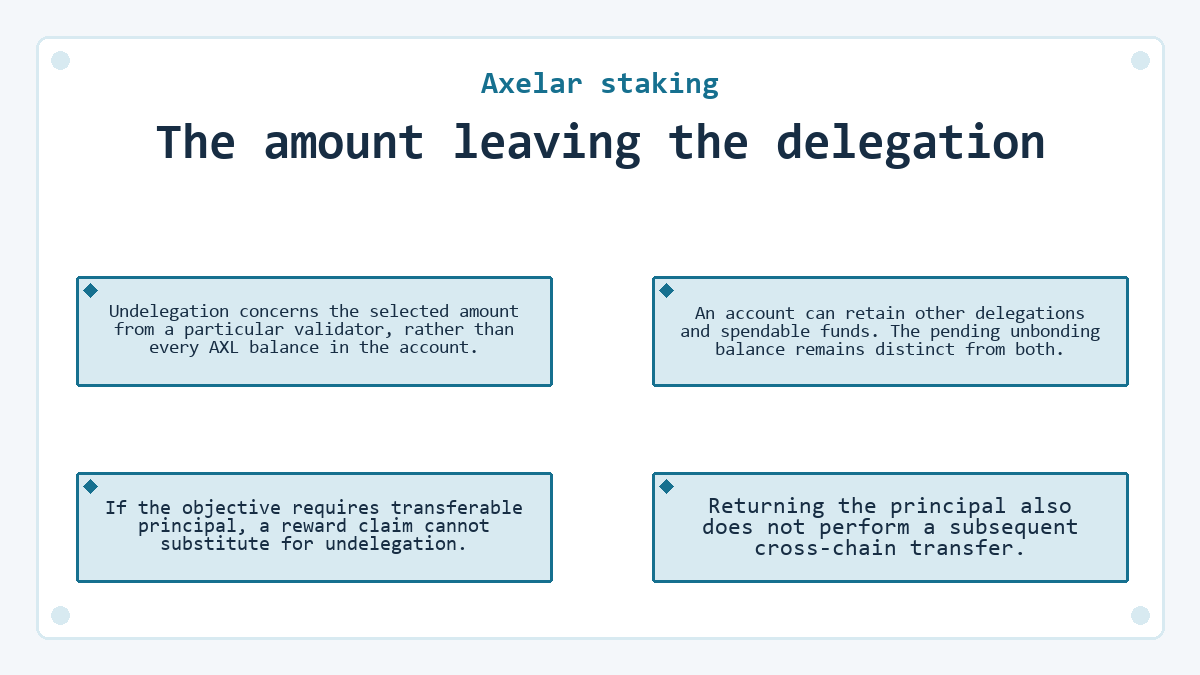
Undelegation concerns the selected amount from a particular validator, rather than every AXL balance in the account. An account can retain other delegations and spendable funds. The pending unbonding balance remains distinct from both. If the objective requires transferable principal, a reward claim cannot substitute for undelegation. Returning the principal also does not perform a subsequent cross-chain transfer.
A recorded stake without an assumed return
In this hypothetical example, a reader plans to delegate 128 native AXL while retaining a separate spendable fee reserve. The account has no existing delegation to the selected active validator.
Before authorizing and submitting the delegation, the reader can abandon the proposed action and retain spendable tokens. After submission, the transaction hash provides a way to inspect the chain result. It does not establish that the validator has received the intended delegation.
Here, the transaction succeeds, and the account’s delegation record shows 128 AXL associated with the selected validator. Matching the account, validator, and amount confirms the intended staking participation. No assumed annual return enters that conclusion; the actual reward balance answers a separate question.
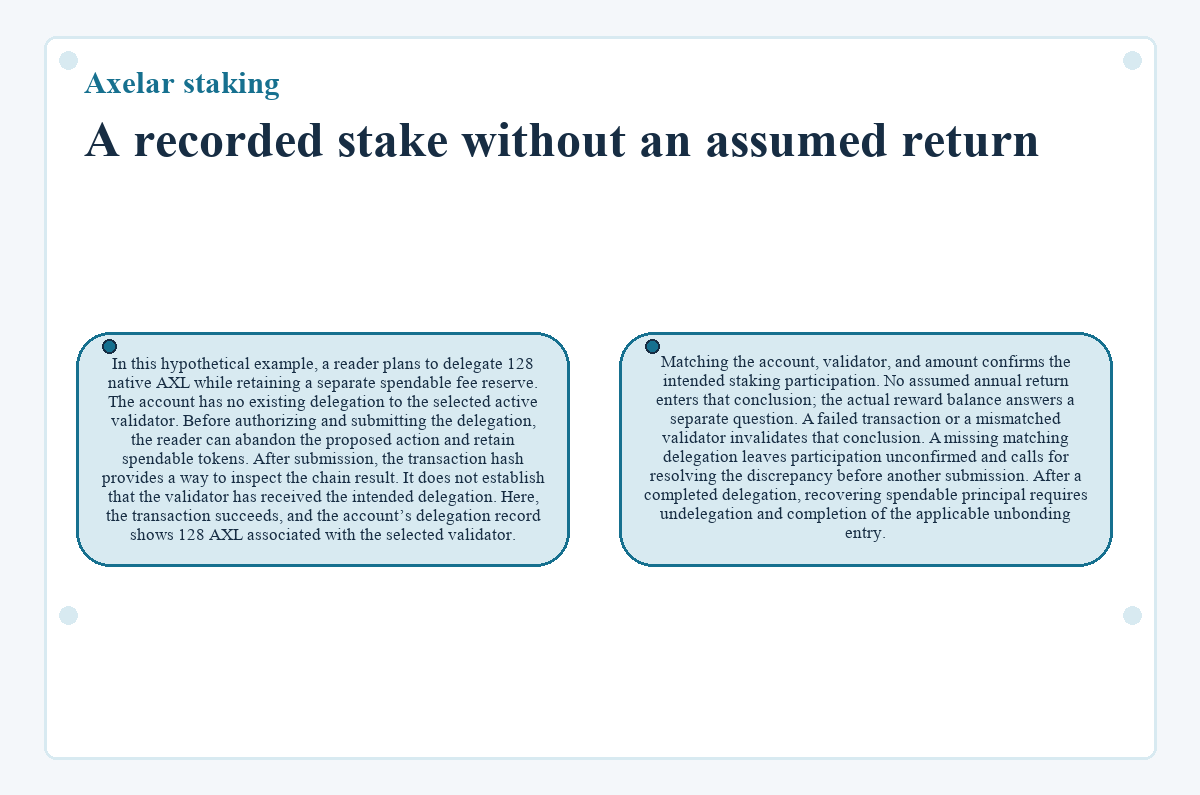
A failed transaction or a mismatched validator invalidates that conclusion. A missing matching delegation leaves participation unconfirmed and calls for resolving the discrepancy before another submission. After a completed delegation, recovering spendable principal requires undelegation and completion of the applicable unbonding entry.
Does changing validators release my staked AXL?
Redelegation moves an existing stake between validators without returning that amount to the spendable wallet balance. It fits a change in validator choice while keeping AXL staked. The network restricts successive moves when an incoming redelegation remains pending for the account and proposed source validator. A changed delegation and a pending redelegation record can therefore coexist. During that pending period, the moved stake can still face slashing for an offense that occurred while it supported the source validator. When the objective is to send or otherwise spend the principal, undelegation addresses that need.
Axelar staking questions, answered
Can one Axelar account delegate AXL to several validators?
One Axelar account can maintain delegations to several validators. Each delegation associates part of the account’s stake with a particular validator. The account can inspect its delegations together or query a specific account-and-validator pair. Spreading stake changes which validator operates each portion; it does not remove the protocol conditions that apply to those delegations.
Must I undelegate my principal before claiming AXL staking rewards?
Accrued delegation rewards can be withdrawn without undelegating the bonded principal. Reward withdrawal is a distribution action, while undelegation removes an amount from a validator’s stake and starts unbonding. A wallet may present these actions near each other, so the transaction’s requested action determines which balance changes. Claiming rewards alone leaves the principal staked.
Will claiming native AXL rewards automatically increase my delegation?
A reward withdrawal alone does not increase the bonded delegation. Compounding requires an additional delegation of those rewards, whether a wallet arranges it or the holder submits it separately. Wallet features differ, so a completed reward claim does not establish that restaking occurred. The delegation balance shows whether additional AXL actually entered the stake.
Where can I inspect the address that receives my staking rewards?
The account’s distribution withdrawal-address record identifies the destination for staking reward withdrawals. Axelar provides the distribution query named delegator-withdraw-address and an action to change it when the network permits changes. A configured destination can differ from the delegating account. Reward delivery to that address does not transfer ownership of the account’s bonded delegation.
Can an unbonding AXL balance still face slashing?
An unbonding balance can remain subject to slashing for a validator offense that occurred while the tokens contributed to its stake. Starting undelegation does not erase that earlier exposure. The applicable infraction height and the unbonding entry’s maturity matter. Consequently, an initial unbonding balance and the amount eventually returned need not always match.
Do I need to operate a validator node to delegate native AXL?
Direct delegation through a compatible wallet does not require operating a validator node. The selected validator runs the network infrastructure, while the delegator authorizes staking transactions from an account. Becoming a validator is a separate operational task that involves node software and network duties. Delegating AXL does not turn the wallet into a validator.
Does quadratic cross-chain voting determine AXL staking reward weight?
Axelar distinguishes quadratic weighting for cross-chain validation from the staking weights used for block production and rewards. Its security model applies square-root-of-stake weighting to cross-chain requests, while the underlying proof-of-stake consensus uses stake-proportional weighting. A description of quadratic cross-chain voting therefore does not establish that a delegation earns rewards in proportion to the square root of its amount.